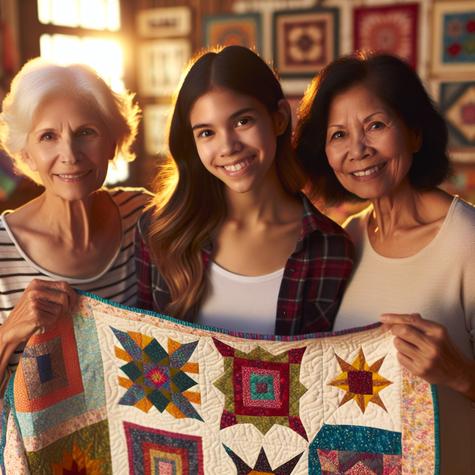
Three Generations Stitched Together

In the quaint town of Homewood, a precious heirloom had been passed on, generation after generation, not as an inanimate memoir but in the form of quilting, an intricately crafted love. This enchanting story began with Grandma Emily, a woman of extraordinary patience and creativity.

Emily, where others saw scrap fabrics, she viewed a canvas of limitless possibilities. So began the tradition of quilt making in her humble home. Her skilled hands would shape, sew, and stitch each fragment into a masterpiece, each holding intimate tales of their era. The patterns she chose, the colors she employed were not random episodes of creative spurts but were carefully selected to resonate with specific family memories.

Emily’s daughter, Elizabeth, was born amidst these swirls of fabrics, the hum of the sewing machine a constant lullaby in her childhood. From an early age, she sat by Emily’s wooden frame, eyes wide with curiosity, grasping the massive tapestry of overlapping geometric shapes with her tiny fingers. Emily, beaming with pride, saw herself in her daughter, nurtured Elizabeth’s nascent fascination, passing her knowledge, skills, and more importantly, her love for quilting.

Elizabeth, brimming with her mother’s passion, began to weave her stories into the quilts. Her first quilt narrated her blooming love for her high school sweetheart, Tom. Every heart and word she stitched held the bashful desires of a smitten girl, each seam whispering tales of stolen kisses and innocent promises. But her most cherished quilt was the one she made for her daughter, Isabella, when she left for her first year of college.

Isabella was the third generation to inherit the intricate artistry. It was not merely quilt making; it was a language she shared with her mother and grandmother. A language that spoke of happiness and loss, of hope and despair, which captured all the moments of her life.

Her hands work diligently, fashioning an intricate pattern of pinkish hues – a quilt for her baby girl, Lily. As she stitched, she remembered how her mother used to tell stories about each blanket, how they were not just practical necessities but symbols of love and togetherness. Looking at her quilt, she didn’t see just fabrics and threads but the childhood warmth of her grandmother’s home, her mother’s laughter, her own recollections of youth, and now, the arrival of her daughter.

Isabella, now a grown woman, an accomplished quilter cherishing the years of wisdom she had been passed on, appreciated the value of this inherited tradition than ever before. She could feel the profound connection resounding in every quilt, a bond embracing three generations of women in her family. The quilting rituals brought an overwhelming sensation, a stirring in her heart as if Emily, Elizabeth, and she were sitting together, three eras converging in a single instance, surpassing the boundaries of time and space.

Emily had been a woman whose life was stitched into her quilts; her love, her dreams, her fears, and her yearning. Isabella clearly remembered one Sunday evening when she was a child. Emily confided in her, “Darling, quilting isn’t about piecing random materials together. It’s about storytelling, about embedding each significant moment of our lives into them.”

As Isabella finished the last stitch of Lily’s quilt, she realized what Emily meant. Her grandmother conveyed her lore to her mother, who passed it on to her, and now it was her turn to preserve this invaluable heritage and transfer it to Lily. This quilt was not just a blanket, but a hereditary narrative that Lily would sense every time she would snug herself in it.

Once Lily was old enough, Isabella reintroduced her to the world of quilting. Initially, the little girl was more interested in the vibrant colors and myriad patterns. Slowly as she grew, Isabella started to weave the tales associated with each quilt, gradually revealing the family saga concealed in the colorful patches.

As Lily grew, she understood the importance of the quilts, the warmth of her great grandmother Emily, and the love of her grandmother Elizabeth, and the keenness of her mother, Isabella. She learned the narrative of each stitch. Lily followed the footsteps of the precious women in her family lineage, as her fingers began to play with the needles and threads under her mother’s watchful eyes, spinning the legacy forward.

The quilting tradition was not just about stitching together pieces of fabrics. It was a chronicle of love, a feat that materialized the invisible string that tied Emily, Elizabeth, Isabella, and now Lily. It was about generations of women, who sat together under the same roof, shared stories, laughter, and tears, crafting their lives into the quilts, ensuring their heart beats in each seam.

Quilting became more than a shared hobby, more than an heirloom craft, it was the tapestry of their family history that narrated their resilient, beautiful bond. Through quilting, Emily, Elizabeth, and Isabella managed to stitch their love for their family and pass it on to Lily; their legacy stitched in love and cloaked in patterns of fabric.

9 Important Things to Know About PCOS

When my sister was hit with Polycystic Ovary Syndrome (PCOS), I decided to learn more and wrote this article. I was amazed at what I found doing the research. There are many misconceptions where PCOS is concerned. Many people make mistaken assumptions, and it can be hard to separate fiction and fact. To that end, here are several need-to-know facts about the condition.

It May Start in the Brain Rather Than the Ovaries

Science is just beginning to understand this connection. According to research out of Australia, rats and mice without androgen receptors in their brains will not develop the condition. However, those with receptors in the ovaries could still get it. This research can help scientists develop treatment options and potential cures.

It’s Hard (But Not Impossible) to Lose Weight

This is one of the most frustrating and difficult symptoms of polycystic ovarian syndrome. Many women know they need to lose weight to improve their symptoms, but most doctors don’t tell them how to do it. Traditional methods are largely ineffective with the condition, as they fail to address underlying hormonal disorders. However, if a patient can get her symptoms and her hormones under control, she can lose weight successfully.

It Doesn’t Go Away With Menopause

Many believe the condition goes away when menopause starts, but that’s another mistaken assumption. Women with polycystic ovarian syndrome undergo fundamental pancreatic changes that lead to insulin processing issues, and the problem doesn’t stop with menopause. However, some symptoms, such as post-menopausal weight gain, do improve.

It Can Make Patients Feel Tired

This condition is linked to chronic inflammation, which can leave patients feeling sluggish, fatigued, achy, and tired. Patients can take steps to fight it, though, such as taking omega-3 supplements and following a proper diet.

The Condition Causes Cravings, Which Can be Beaten

Many women with this condition report having intense cravings for certain foods, which can quickly derail even the best diet. However, cravings can be effectively managed as patients address insulin and hormone problems.

Natural Pregnancy is Possible

Polycystic ovarian syndrome is one of the main causes of female infertility, but it is possible to get pregnant through natural means. If a patient can get her hormones under control, she’s more likely to have a regular ovulation cycle, which makes it easier to conceive naturally.

Polycystic Ovarian Syndrome Causes Secondary Health Issues

When most women think of this condition, they think of its short-term effects. However, it’s also important to think in the long term. Various secondary health issues, such as diabetes, heart disease, and high cholesterol are all linked with this condition, and that’s why it’s important to get it under control quickly.

A Hysterectomy Won’t Solve the Problem

When a patient thinks of the condition, they may think of it as a problem to be addressed by a gynecologist. After all, it causes problems with the ovaries and the menstrual cycle. The condition is multifaceted, though, and it affects the pancreas, the adrenal glands, and the brain. Therefore, a hysterectomy will not alleviate the symptoms of polycystic ovarian syndrome.

It Can’t Be Cured, Only Managed

As of now, there’s no cure for polycystic ovarian syndrome. Therefore, patients need to learn proper management and mitigation techniques. Women can lessen the symptoms by eating right, taking doctor-recommended supplements and making other lifestyle changes.

Conclusion

Women with this condition have choices to make. They can choose to ignore the symptoms and their effects, or they can acknowledge the condition for everything it is and decide not to let it define who they are. By making daily decisions to manage the condition, patients can live a fulfilling life without letting polycystic ovarian syndrome get in the way. If a reader believes they may have this condition, they should consult a physician as soon as possible.

By the way, my sister got PCOS treatment in DFW mid-cities, and she is doing fine now.

Three Sewing Videos For Your First Quilts

Learn New tricks with Circular Sewing Attachments


Creating something new and unique that is easy, is such fun. See the pattern in the video for the concentric circles, with machine embroidery in the middle. Use on clothes, or however you see fit.

Sew Easy lesson: Interfacing Applique


How to get outer edge of your cicle nice and smooth. Trace around it (cut out with scissors), leave the bumpy/glue side toward the fabric.
Then sew it all the around, then trip quarter inch all they around the circle, cut slit in the fold, then turn inside out. Then use an “applique pressing sheet”, then press with an iron. Then you can do perfect stitching around your perfect circle.

The Backroom Quilter – Gayle Ropp


She has a product call “Spool Swing”. This allows you to position your needle with this little tool, without having to stick your finger.

What To Consider When Starting A New Hobby

There are many hobbies today that people find interesting to do in their spare time, but unfortunately there are just plenty who have no idea what ideas to pursue. If you are confused about what might be a good hobby, don’t worry because the following article has many great tips. Read on for great ideas about hobbies.

To help you stay stress-free take up a hobby. Hobbies offer you a way to escape the daily grind and enjoy yourself. If you don’t have a hobby, consider what you enjoy doing. Do you enjoy art? If so, take a painting class or a sculpting class to learn a new hobby.

When you are deciding on a hobby, there are some basic things you should think about first. The cost of the supplies or equipment, the space needed, and how much time you will need to spend are all factors to consider. Planning before you start can make your hobby more enjoyable in the long run.

If you are very passionate about a particular hobby, consider turning it into a business for yourself. Start small, learning the ins and outs, while keeping a dependable source of income going, then branch out as the business takes hold. If you work hard at it and luck is on your side, you could end up doing what you love, rather than the typical nine to five!

A fun and potentially rewarding hobby to have is poker. Poker is fun because you can play it with your friends, and win a bunch of money at the same time. You can also lose a bit of money, so you’ll want to practice a lot and really know your stuff.

Think about hobbies that can make you actual money! Hobbies don’t need to only burn holes in your pockets. They can actually fill up your coffers as well. You could look into app development, website development, landscaping, gardening, and a lot of other hobbies where you could make a few bucks.

Caving could be a fun hobby if you live in a good area for it. The key to doing this hobby well is preparation combined with knowledge. Finding a guide to take you into the caves is the safe way to explore.

You do not need to restrict yourself to just one hobby. Diversity prevents boredom and promotes self-development. A good way to divide your hobbies up is to break them down on what is best for that time of year.

Are you looking for a hobby to fill your time and want to get fit? Swimming might be an option for you to consider. It may cost a little each month to pay membership fees for the pool, but many people find great joy in swimming laps each day. The health benefits are great and so is the potential of picking up a fun hobby that you enjoy.

There are some hobbies that can cost you little or even nothing. One of the most overlooked hobbies is reading. Pick up a book and allow the stories in it to carry you away. Take out books from the library and it will not cost you a single red penny to keep up with this hobby.

If you are looking to find a new hobby, visit your local hobby or arts and crafts sores. They will have a huge selection of materials for hobbies, along with the finished creations from people who excel in that hobby. many hobby stores also offer free classes to help you get started.

If reading is a passion of yours but have become inundated with too many books, you can think about selling them at a used book store. This gives your home some space and you some credit towards new books. Once you find a genre that you like, reading is a truly relaxing hobby.

Finding a hobby is not that easy for a lot of people. Many people never know where to begin when it comes to hobbies. Thankfully, the above article gave great ideas on where to find that special hobby. Better yet, pass along these tips to your family members so they too can partake in these great hobbies.

Also check out quilting.about.com.